Chapter 2 · Engineering · 2026

F1 in Schools

Design Lead, Team Rogue Velocity, STEM Racing India Season 8. Best Engineering, Design and Innovation Award at the Open National Finals, Chennai, August 2026.

Design Lead · Team Rogue Velocity · STEM Racing India (F1 in Schools), Season 8 · 2026

I owned the car's geometry, the physics model justifying it, and final technical sign-off across a six-person team.
CFD
OpenFOAM virtual wind tunnel, k-ω SST. Mesh study on the Mach 4.2 Regionals car (3.76 M cells); final Cd 0.7075 from a 5.42 M-cell run on the Mach 7 Nationals car
Structure
FEA toolkit for wheels, axles and chassis
CAD
Full parametric model, 40 STEP/STL/F3D files
Docs
Contributed to the team's three submitted portfolios: Design & Engineering, Enterprise, Project Management
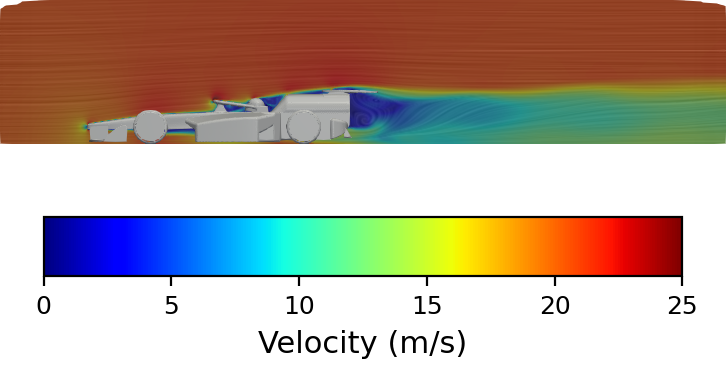
Side-view line-integral-convolution flow over the car, coloured by velocity from 0 to 25 m/s; the wake behind the rear wing is slow and blue.
Fig. 1Line-integral-convolution flow over the car, side view. Mach 4.2, the Regionals car. Colour is velocity, 0 (blue) to 25 m/s (dark red); the colour bar is cropped from this plate.
Cd0.7075

The final drag coefficient, from a 5.42 M-cell k-ω SST run on the assembled Mach 7 Nationals car. In the Python race simulator, MRM 5, it replaced the 0.74 converged on the Regionals car; MRM 5 is calibrated against three rival cars reconstructed from their published portfolios.

Predicted race time0.892–0.895 s
Peak velocity · peak thrust (raw model)27.55 m/s18.8 N
  1. Nine design iterations, Prototype 1 to the Mach 4.2 Regionals car. Scroll to step. The Nationals car, Mach 7, is not on this sheet.
01/09
9th of ~105

At Regionals, where the top 14 advanced. At the Open National Finals in Chennai, August 2026:

Best Engineering, Design and Innovation Award